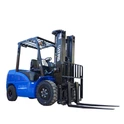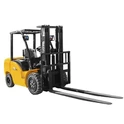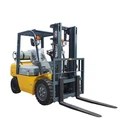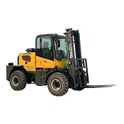
In modern logistics and warehouse operations, forklift attachments such as fork extensions, paper roll clamps, and jib booms significantly expand the versatility of a forklift. However, many operators and managers overlook one critical question: Do forklift attachments reduce the forklift's original load capacity?
The answer is yes, and ignoring this fact is one of the leading causes of forklift-related accidents. This article will help you understand exactly how forklift attachments affect load capacity and stability, and provide a practical guide to safe evaluation and operation.

The Basics: Load Center and Load Moment
To understand how attachments impact capacity, you first need to know two key concepts:
- Load Center: The distance from the vertical face of the forks to the load's center of gravity. Forklift manufacturers base rated capacities on a standard load center, often 24 inches (600 mm).
- Load Moment: Calculated as load weight × load center distance. The larger the load moment, the higher the risk of forward tipping.
Key takeaway: Any change to the load center - especially when using attachments - directly alters the load moment, which reduces the forklift's safe lifting capacity.
How Forklift Attachments Reduce Load Capacity
Attachments can reduce forklift capacity in two major ways:
- Shifting the Load Center
Attachments like fork extensions or jib booms move the load's center of gravity further forward. This increases the load center distance, raises the load moment, and decreases overall stability. For example, a forklift rated for 5,000 lbs at a 24-inch load center can lose significant capacity if the center shifts out to 30 inches.
- Adding Dead Weight
Every attachment has its own weight, which reduces the amount of load the forklift can safely handle. Even if the load center remains unchanged, the usable lifting capacity decreases because part of the forklift's rated capacity is consumed by the attachment itself.

How to Recalculate Forklift Capacity with Attachments
A simplified formula can be used to estimate the new safe capacity:
New Capacity ≈ (Original Capacity × Original Load Center) ÷ New Load Center
Example:
A forklift rated at 5,000 lbs with a 24-inch load center is fitted with an attachment that shifts the load center to 30 inches.
New Capacity = (5,000 × 24) ÷ 30 = 4,000 lbs
That's a full 1,000 lbs reduction in safe lifting capacity.
For operator safety, it's strongly recommended to install an updated data plate (also called an alternate capacity plate) clearly showing the forklift's adjusted rating with the attachment installed.
Additional Factors That Affect Capacity
Beyond the load center, several other factors also reduce forklift stability:
- Attachment Center of Gravity: The horizontal and vertical balance of the attachment itself.
- Irregular Loads: Off-center, asymmetrical, or unstable loads further reduce safe capacity.
- Operating Conditions: Sloped floors, sharp turns, or sudden stops all magnify risks when attachments are used.
Safety Tips for Using Forklift Attachments
- Check Before Use: Always review the updated data plate for the adjusted capacity.
- Operate Smoothly: Drive and turn slowly, avoiding sudden acceleration, braking, or sharp turns.
- Get Proper Training: Operators should receive specific training on each attachment, including installation, capacity limits, and handling techniques.
- Test Before Full Loads: Start with lighter loads to test forklift stability, then gradually increase the weight.
Compliance and Responsibility
- Clear Capacity Labeling: Safety standards require that any capacity change due to attachments be clearly displayed on the forklift.
- Corporate Responsibility: Using attachments without proper adjustments creates safety risks, equipment damage, and potential legal liability.
- Routine Inspections: Regularly inspect attachment connections, hydraulics, and wear to prevent hidden hazards.
Compliance and Responsibility
Clear Capacity Labeling: Safety standards require that any capacity change due to attachments be clearly displayed on the forklift.
Corporate Responsibility: Using attachments without proper adjustments creates safety risks, equipment damage, and potential legal liability.
Routine Inspections: Regularly inspect attachment connections, hydraulics, and wear to prevent hidden hazards.