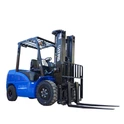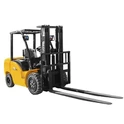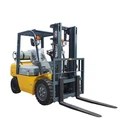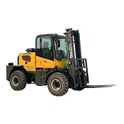
Construction sites rarely have the smooth, stable surfaces found in warehouses. Gravel roads, ruts, soft soil, and mud after rain can all affect a forklift's mobility and load stability. Choosing the right machine for these conditions helps move materials to the work area safely and efficiently.
This guide covers job site conditions, tire and drive configurations, load weights, and lifting requirements to help you choose the right rough terrain forklift. It also uses a real customer case to show how these forklifts are used on job sites.
Why Standard Forklifts Struggle on Rough Terrain
Standard diesel forklifts and electric forklifts are designed primarily for firm, level surfaces. Their tires, ground clearance, and traction may not be suited to ruts, loose gravel, mud, or slopes. On uneven ground, the wheels may lose traction or spin, making it harder to travel steadily with a load.
Limited ground clearance can also make the underside of the machine or the mast more likely to strike raised stones and uneven surfaces. Solid tires suited to clean concrete may transmit more impact on rough ground and may not provide enough traction on soft surfaces.
That said, not every outdoor job requires specialized equipment. A suitable standard forklift may work on a firm, well-prepared site road. But if the route from the delivery point to the work area is often unpaved or uneven, consider a rough terrain forklift designed for those conditions. The right choice also depends on the surface, weather, route length, slope, and load.
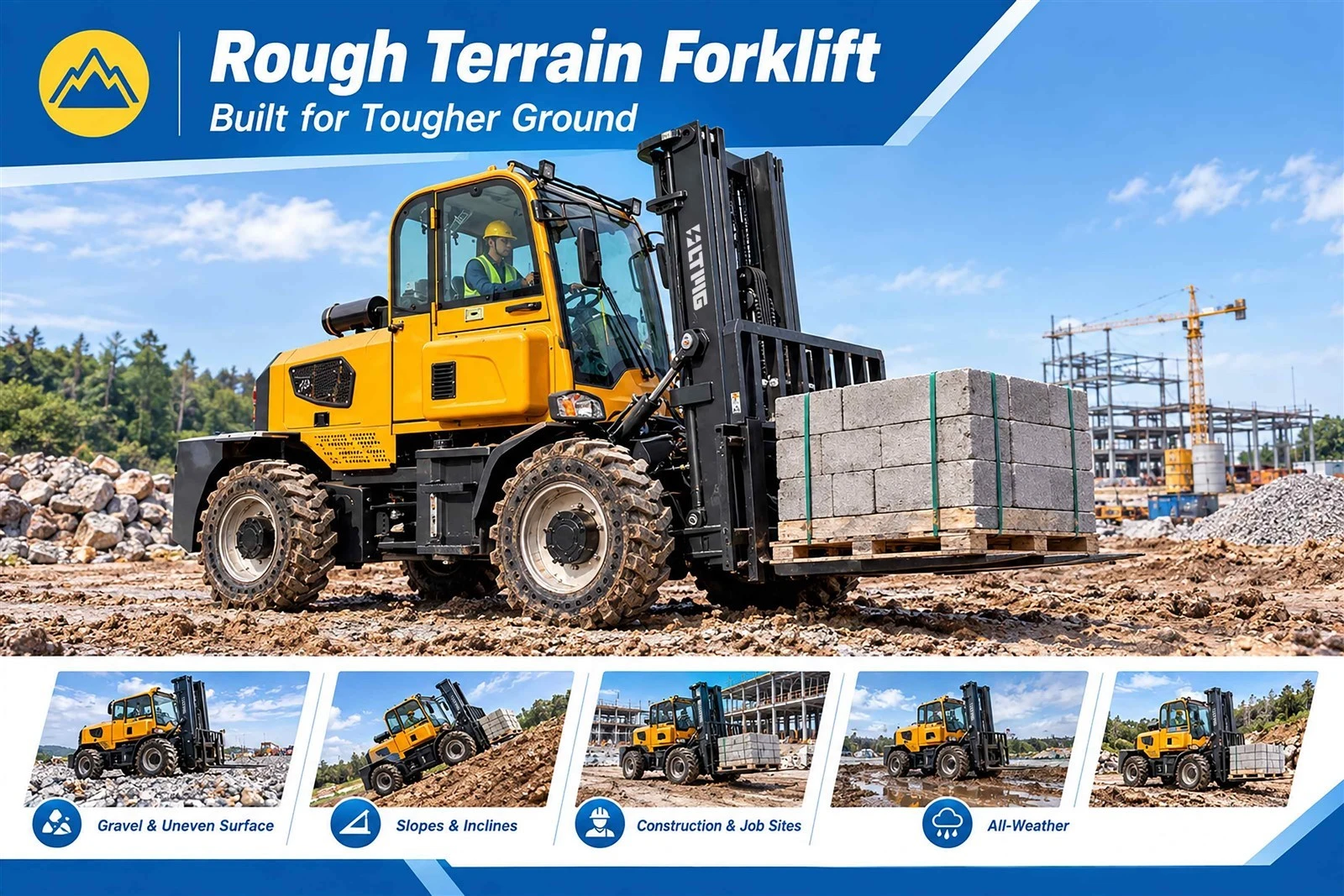
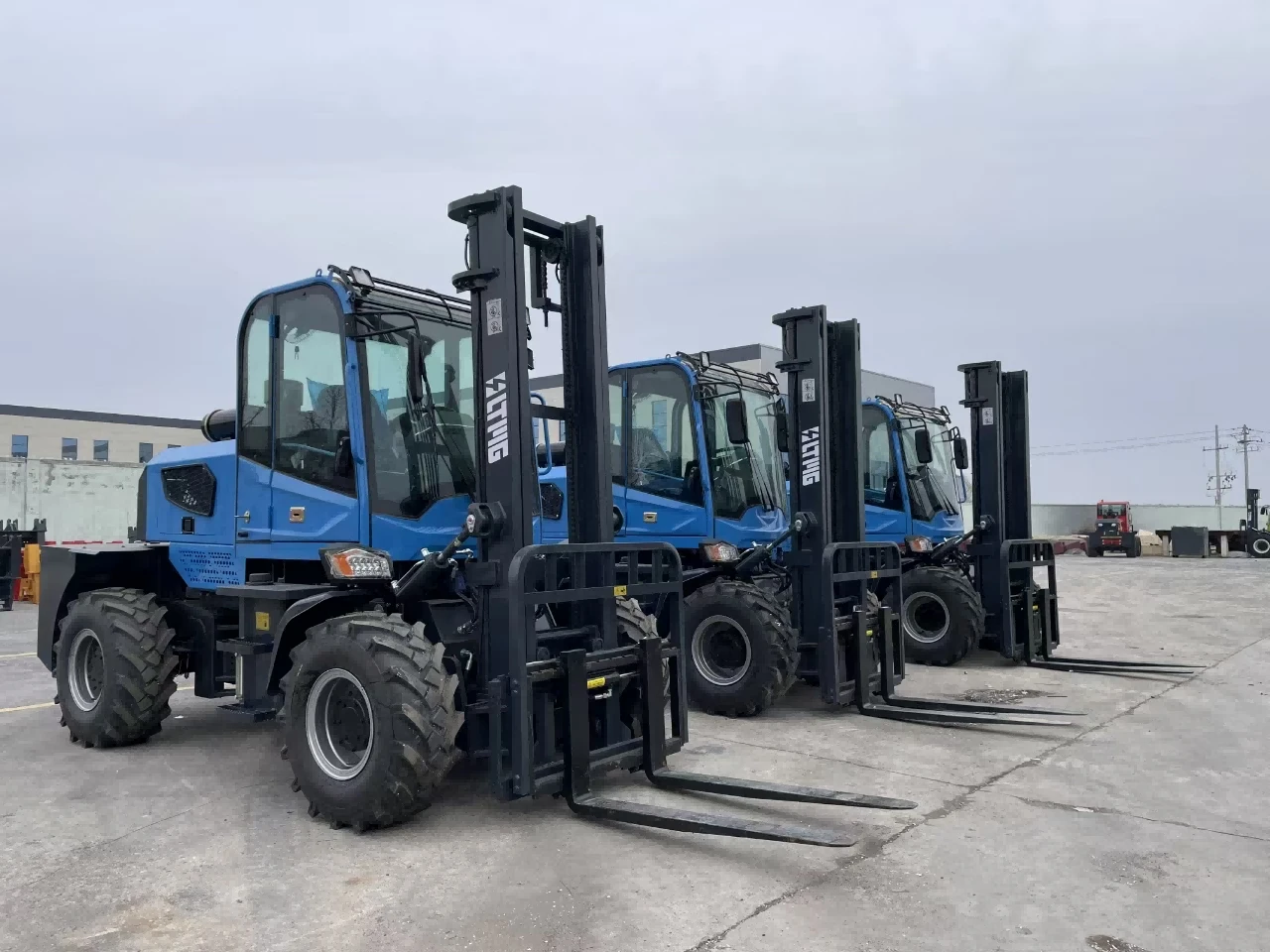
Key Features: Tires, Ground Clearance, and 4WD
Tires affect traction, mobility, and ride comfort. Pneumatic tires are commonly used for outdoor work because they can handle uneven surfaces better than typical forklift tires. Tire size and tread should suit the ground conditions: loose gravel, compacted soil, and wet mud place different demands on the tires. Tires alone do not make a forklift suitable for every surface, so check the manufacturer's recommendations for your application.
Ground clearance helps a forklift pass over ruts and raised obstacles without scraping the underside of the machine. When comparing specifications, check which part of the forklift the stated ground clearance refers to.
Four-wheel drive (4WD) can help a forklift maintain traction on soft or uneven ground. It is one part of the machine's overall suitability, alongside tires, weight distribution, steering, and operating technique. On slopes or soft ground, travel slowly, keep the load low, and follow the operating instructions for the specific model.
Common Job Site Applications: Roofing, Landscaping, and Lumber Handling
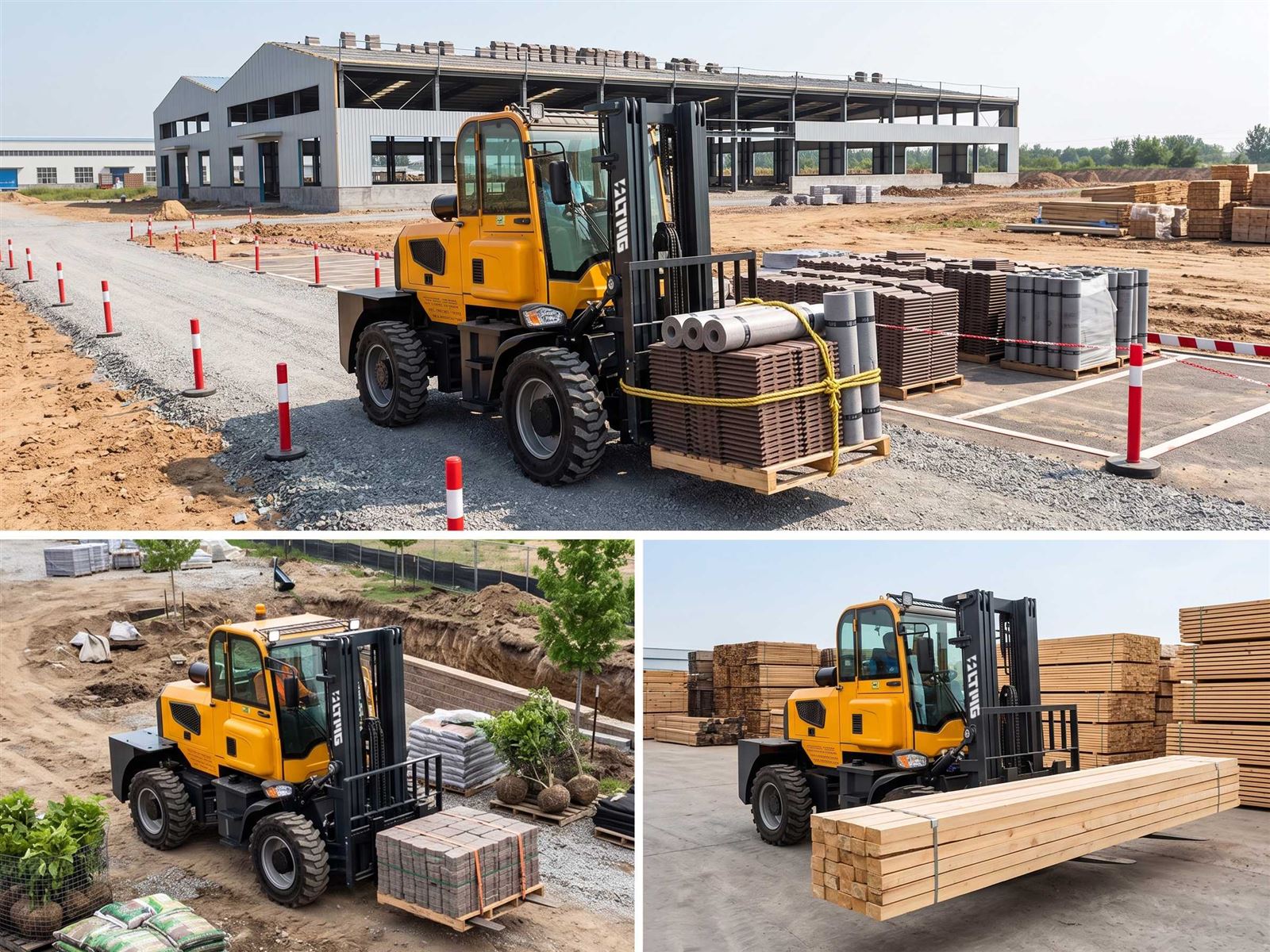
On roofing projects, a rough terrain forklift can move palletized shingles, underlayment, and other supplies from the delivery point to a staging area. Assess the travel route and unloading position carefully: the forklift must be able to reach the work area safely, and the load must remain within its rated capacity. Do not use a forklift to lift people or place materials directly on a roof unless the equipment and procedure are specifically designed and approved for that purpose.
In landscaping, a rough terrain forklift can move pavers, bagged soil, plants, and other supplies across parts of a site that are not fully paved. Pay particular attention to soft ground. A loaded forklift may sink or lose traction, so assess whether the ground can support the machine before operating.
For lumber and building materials, forks can handle suitable loads that are properly bundled and secured. Long or irregularly shaped materials may shift or extend beyond the forks, so operators should consider load length, center of gravity, visibility, and the travel route. Use only approved attachments and follow the rated capacity for the machine's configuration.
These are potential applications for rough terrain forklifts. Actual suitability depends on the load, ground conditions, travel route, and the machine's rated capacity.
How to Choose Capacity for Building Material Handling
Start with the heaviest load the forklift will need to handle regularly, rather than the average pallet weight. Then consider the load center, lift height, fork length, and attachment configuration. A forklift's rated capacity may not apply to every lift height or attachment combination, so consult the capacity chart for the specific model.
When handling bricks or concrete blocks, calculate the weight of the complete pallet or bundle, including packaging. If possible, ask the supplier for the actual shipping weight and allow for reasonable variations. Do not estimate capacity based only on the number of bricks: brick size, density, pallet dimensions, and moisture can all affect the total weight.
Next, plan the full route from the delivery vehicle to the placement area. Check turning space, ground bearing conditions, slopes, overhead obstructions, and the required lift height. A forklift may have enough capacity on paper but still be unsuitable if the route is too narrow or the ground is unstable.
Take the LTR35, a 3.5 ton articulated rough terrain forklift, as an example. Its rated capacity is listed as 3500 kg, which may suit some building material handling tasks. However, the specification sheet alone cannot confirm whether it can safely handle a particular pallet at a specific height. Before choosing a model, check its capacity chart and share the job site conditions and load dimensions with your supplier. For unusually heavy or long loads, evaluate the complete machine configuration rather than relying on the model name alone.
Take the LTR30, a 3 ton articulated rough terrain forklift, as an example. Its rated capacity is listed as 3000 kg, which may suit some building material handling tasks. However, the specification sheet alone cannot confirm whether it can safely handle a particular pallet at a specific height. Before choosing a model, check its capacity chart and share the job site conditions and load dimensions with your supplier. For unusually heavy or long loads, evaluate the complete machine configuration rather than relying on the model name alone.
Customer Case: The LTR50 Handling Lumber on a Job Site in Cameroon
At a lumber work site in Cameroon, the customer needed to move long pieces of timber across unpaved ground. The lumber was stacked in a designated area, and the forklift had to travel between the storage area and work locations to load, unload, and move materials around the site. Compared with a warehouse floor, these conditions placed greater demands on the machine's load capacity, tire suitability, and ability to travel over the site.
The customer chose the LTR50 for lumber handling. The model has a rated capacity of 5,000 kg and four-wheel drive, making it suitable for material handling on unpaved sites. Based on the ground conditions and application, the machine was equipped with semi-pneumatic tires. These help reduce concerns about punctures from sharp debris and the need for frequent tire pressure checks. For lumber operations, this can help limit tire maintenance interruptions to daily handling work.
During the selection process, our sales team used the customer's information about timber weight and length, handling frequency, and site conditions to help confirm the machine's capacity and tire configuration. The team also discussed travel routes, available working space, and operating requirements. After delivery, we provided guidance on operation and routine maintenance to help the customer become familiar with the forklift and put it to work on site.
The customer said: "We are very satisfied with the LTR50's performance, especially the four-wheel drive and semi-pneumatic tires recommended by the LTMG sales team. They help us move lumber over uneven ground and meet our material handling needs. The LTMG team has also been very professional and provided us with helpful operating guidance."
Conclusion
When choosing a rough terrain forklift, start with the actual job site conditions. Identify whether the ground is gravel, mud, or sand; measure the width and slope of the travel route; and confirm the weight and dimensions of the heaviest load, along with the required lift height. Then compare rated capacity, tire type, ground clearance, and drive configuration. Check the capacity chart to make sure the forklift can handle the load in the configuration you plan to use.
If you are choosing equipment for a construction site or lumber handling project, share your site photos, route details, and load specifications with the LTMG team. We can help assess the application, compare models and configurations, and recommend a rough terrain forklift for your project.

Frequently Asked Questions
Can a rough terrain forklift operate in mud or sand?
-
It may operate on some muddy or sandy surfaces, but capability depends on soil firmness, moisture, depth, slope, tires, machine configuration, and load. Soft or saturated ground can cause a forklift to sink or lose traction. Assess the route before operating, and follow the manufacturer's limits. Do not assume that 4WD makes every surface safe.
What capacity do I need to handle bricks or concrete blocks?
-
Choose a forklift based on the verified weight of the complete pallet or bundle, then check the capacity chart for the required load center, lift height, and attachment. There is no single tonnage that fits every brick or block load. Ask the supplier for the package weight and confirm the machine's capacity for that specific configuration.
Can a rough terrain forklift travel on public roads?
-
Road use depends on the machine's configuration and the laws where it will operate. A forklift suitable for a job site may still need registration, lighting, insurance, or other approvals for public-road travel, and some models may need to be transported between sites. Check local requirements and the manufacturer's documentation before driving on a public road.