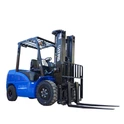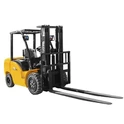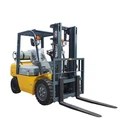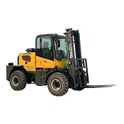
Forklift attachments break the limits of standard "up-and-down" lifting by adding hydraulic adjustment functions to standard forks. Among the wide variety of attachments, Side Shifters and Fork Positioners are the most frequently asked about and easily confused. Both move forks horizontally, and both promise to boost material handling efficiency.
Choosing the wrong attachment can reduce your truck's rated load capacity and lower operational efficiency. This guide breaks down their mechanical differences, application scenarios, and key selection factors to help you make the right investment for your fleet.
What Is a Forklift Side Shifter?
A side shifter is mounted between the carriage and the forks. Powered by an internal hydraulic cylinder, it shifts the entire carriage assembly left or right along a guide rail. The spacing between the two forks remains fixed-only their overall horizontal position shifts.
Primary Function: When a pallet is not perfectly aligned with the forks, the operator can adjust the position horizontally via a control lever without maneuvering the entire forklift. This is essential for narrow-aisle warehouses, double-deep racks, and container loading where steering maneuverability is restricted.
Key Limitations:
- Fixed Spacing: It shifts the entire carriage; it cannot adjust the gap between the individual forks to fit different pallet sizes.
- Capacity Derating: Adding a side shifter reduces the forklift's net lifting capacity due to shifts in the load center distance. Always check the updated load chart before operation.
- Wear & Tear: Frequent off-center loading accelerates wear on guide rails and cylinder seals, requiring regular maintenance.
What Is a Forklift Positioner? (Principle & Limitations)
A fork positioner also mounts on the carriage, but its hydraulic system controls the relative distance between the two forks. Operators can expand or narrow the fork spread at the touch of a button-eliminating the need to manually stop, dismount, and drag heavy forks into place.
Note: High-end models often integrate side-shifting capabilities (Integral Side-Shifting Fork Positioners), which combines width adjustment with total lateral shifting.
Primary Function: In facilities handling multiple pallet dimensions, odd-sized crates, or unpalletized cargo, a fork positioner eliminates manual setup time. It is ideal for multi-category distribution centers and logistics hubs requiring frequent pallet switching.
Key Limitations:
- No Lateral Shift (Standalone): Standard fork positioners cannot move the carriage laterally unless paired with an integrated side shifter.
- Width Capacity Drop: When forks are fully extended, the load capacity per fork decreases. Always adhere to the attachment nameplate rating.
- Maintenance Demands: The mechanical structure is more complex than a basic side shifter, demanding higher hydraulic oil cleanliness.
Side Shifter vs. Fork Positioner: Side-by-Side Comparison
|
Feature / Dimension |
Side Shifter |
Fork Positioner |
|
Adjustment Object |
Entire carriage assembly (Left / Right) |
Spacing between individual forks |
|
Core Problem Solved |
Alignment errors between truck and pallet |
Non-standard or varying pallet sizes |
|
Ideal Scenarios |
Narrow aisles, dense racking, container loading |
Mixed-pallet warehousing, logistics hubs |
|
Load Derating |
Standard reduction applies |
Varies based on open fork width |
|
Combination Options |
Standalone or integrated with positioners |
Standalone or integrated with side shifters |
Essential Maintenance Tips for Hydraulic Attachments
To prevent sudden downtime and extend the service life of your material handling equipment, incorporate these maintenance checks into your daily routine:
- Hydraulic System Audits: Inspect hose fittings for leaks and check cylinder seals for aging to avoid sluggish operation or pressure drop.
- Rail & Screw Lubrication: Regularly grease side shifter guide rails and positioner lead screws to prevent friction and wear.
- Fastener Tightening: Periodically check and retighten bolts securing the attachment to the carriage to withstand continuous vibration.
- Load Chart Compliance: Verify the net capacity chart whenever switching cargo types or working conditions to prevent hazardous overloading.
How to Choose the Right Attachment for Your Business
Consider the following key operational parameters before purchasing:
- Aisle Width & Maneuverability: If space is tight and turning radius is limited, prioritize a Side Shifter.
- Pallet Diversity: If your team manages multiple pallet types or odd-sized loads, a Fork Positioner provides the fastest ROI by reducing manual labor.
- Operating Tempo: High-frequency, fast-paced logistics operations benefit immensely from the seconds saved per load cycle using hydraulic controls.
- Budget vs. Functionality: If you face both alignment issues and varying pallet sizes, an Integral Side-Shifting Fork Positioner offers the ultimate solution in a single unit.
Maximize Your Warehouse Efficiency with LTMG Machinery
Selecting the right attachment isn't about finding the "best" tool-it's about finding the best fit for your specific material handling workflow.
Whether you need standalone side shifters, fork positioners, or custom hydraulic attachments, the LTMG Engineering Team is here to help. Contact us today with your pallet specifications, aisle dimensions, and application requirements. We will provide a customized solution complete with full net load capacity calculations to keep your operations running safely and efficiently.
Need expert advice on optimizing your forklift fleet?
[Contact LTMG Material Handling Experts Today] to request a tailored quote or technical spec sheet!