1. The True Cost of Forklift Blind Spot Accidents
In the precise operations of modern warehousing and logistics industries, forklifts undoubtedly bring great convenience, directly driving the profitability of business operators. However, in the shadow of high-efficiency operations, potential safety hazards still exist-specifically, the forklift blind spot.
According to statistics, any unaddressed blind spot serves as a primary culprit behind operational mishaps. A single, simple obstructed view can do more than just damage goods and disrupt supply chain schedules; it can also lead to irreversible personal injuries. For operations managers, this issue extends far beyond a basic "visibility problem." It represents a major vulnerability directly threatening warehouse security. Recognizing the true cost of a forklift accident is the first step toward building a zero-accident workplace.
2. 5 Critical Blind Spots You Must Watch For
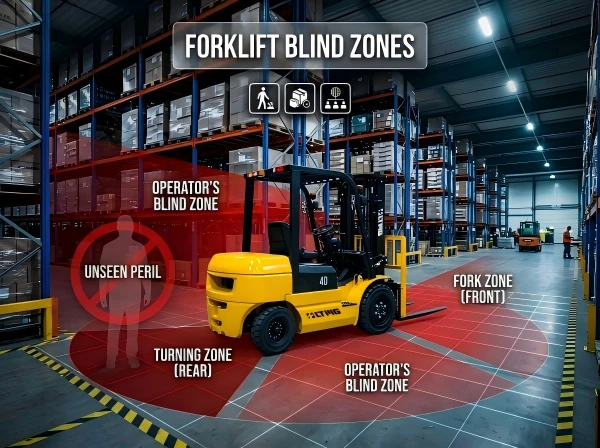
Due to the unique mechanical structure of a forklift, complex warehouse environments, and high-intensity work habits, various visual blind spots can occur. Analyzing the root causes of these common blind spots is essential for developing targeted solutions to eliminate hazards and elevate warehouse forklift safety standards.
(1) Obstructed Forward Visibility
Because the forks are located at the front of the vehicle, the mast structure itself creates a level of visual interference. When a forklift is fully loaded, the cargo often exceeds the driver's eye level, completely blocking the forward line of sight. This obstruction of the road, pedestrians, and obstacles ahead is the most common cause of warehouse collision accidents.
To maintain strict forklift safety, operators are trained to drive in reverse when high loads block forward visibility. However, during high-frequency shifts, prolonged reverse driving causes neck fatigue for the operator and increases the risk of rear-end blind spot accidents.
(2) Rear Vehicle Blind Spots
Conventional counterbalanced forklifts are designed with heavy, bulky counterweights at the rear. Combined with cabin designs that restrict rear-view visibility, operators experience limited awareness of pedestrians and obstacles behind them during reverse maneuvers, making rear-end collisions highly likely.
In traditional safety management, drivers must utilize auxiliary equipment like rearview cameras and mirrors. Before starting their daily shifts, operators must strictly inspect these mirrors and lenses to ensure they are clean and properly adjusted to their seating position, minimizing rear dead zones.
(3) High-Level Stacking Blind Spots
When performing high-level stacking operations, the overhead guard and mast structures obstruct the driver's direct line of sight. Operators often struggle to visually confirm the exact position of the forks during lifting. Even if they lean out of the cabin, they must rely heavily on experience rather than precise positioning, creating a significant risk of falling cargo injuring personnel below.
Before initiating high-level stacking, a strict "falling hazard zone" must be established. While the forks are lifting or lowering, pedestrians must be strictly prohibited from walking, stopping, or working within this area. Furthermore, companies should conduct regular practical training and assessments for high-level operations, training drivers to prioritize cautious accuracy over speed.
(4) Turns and Intersections
When navigating corners-especially within the narrow aisles of modern high-density storage facilities-tall shelving and dense cargo stacks severely compress the lanes. At corners, T-junctions, or warehouse entrances, these physical barriers cut off the direct line of sight between the driver and other vehicles or pedestrians, leading to potential collisions.
Large-view fisheye convex mirrors must be mandatory at all high-risk intersections, blind corners of racks, and entrances to help drivers and pedestrians anticipate movement in dead zones. Concurrently, drivers should follow safe driving protocols by slowing down and sounding their horn before approaching any turn or intersection to compensate for the blind spot with audible alerts.
(5) Tires and Low-Clearance Blind Spots
Because forklift seating positions are relatively high, the driver's lower field of view is often blocked by thick chassis steel plates, battery compartments, or hydraulic units. This creates a low-clearance blind spot around the perimeter of the vehicle, particularly near the outer tires. In these blind zones, a moving forklift can easily run over tools, parts, pallets, or even a pedestrian's foot, resulting in severe personal injuries.
Drivers must perform a pre-shift walk-around inspection to ensure the driving path is entirely clear of debris. When changing lanes, turning, or making U-turns, speeds must be reduced to a minimum while closely monitoring the clearance between the vehicle sides and the floor. Pedestrians and warehouse personnel must maintain high safety awareness, keeping a distance of at least 3 meters from the rear of the vehicle and staying completely clear of the forklift's turning radius.
3. From Traditional to Intelligent: How to Completely Eliminate Blind Spot Hazards
(1) Personnel Safety Management
- Implement Standardized Driver Training: Conduct regular practical assessments targeting blind spots. Build compliant operating habits that rely on standard procedures rather than mere guesswork, transforming safety protocols into muscle memory.
- Enforce Standard Operating Procedures (SOPs): Strictly prohibit fatigued driving and mandate a pre-shift walk-around inspection to ensure the vehicle's path is free of obstacles.
- Pedestrian "Mutual Visibility" Education: Train all warehouse personnel to maintain a 3-meter safety distance from vehicles. Pedestrians must be strictly forbidden from crossing aisles until they have made eye contact with the driver and received a nod of acknowledgement.
(2) Operating Environment Improvements
- Optimize Aisle and Rack Layouts: During the warehouse design phase, scientifically plan forklift turning radiuses and aisle widths to avoid overly narrow corners in high-density zones. Enforce a strict separation of pedestrians and vehicles using physical guardrails or clear floor marking lines.
- Deploy Industrial Convex Mirrors Nationwide: Install industrial-grade convex mirrors at all high-risk visual blind spots-such as high-rack corners, T-junctions, and warehouse entry points-to help pedestrians and drivers see oncoming traffic early. Clean and maintain these mirrors regularly.
(3) Product Configuration Optimization
Vehicle Body Structure Optimization
- Wide-View Masts: By optimizing the mast steel structure and hydraulic hose layout, the forward field of view is significantly expanded, maximizing visibility while maintaining full load-carrying capacity.
- Full LED Lighting Systems: Equipping the vehicle with high-power LED work lights, reverse lights, and blue ground safety projection spots ensures optimal operational light and alerts nearby pedestrians, even in dim warehouse zones.
- Low-Profile Dashboards: Utilizing a lower, more compact dashboard design remarkably improves the driver's downward visibility, especially toward the fork tips.
- Optimized Counterweight Designs: Re-engineering the rear counterweights increases the driver's downward rear-view angle, physically reducing the rear blind spot during reverse operations.
Intelligent Vision and Safety Systems
- Large-Diameter Panoramic Rearview Mirrors: Upgrading to large-diameter, high-curvature panoramic interior mirrors provides drivers with rear and side visibility that far exceeds traditional mirrors.
- Backup Cameras + Buzzers: Installing waterproof and dustproof wide-angle cameras at the rear automatically displays the rear view when reversing, synchronized with a high-decibel buzzer for dual-layered safety.
- Rear and Fork Camera Systems + HD Color Displays: Embedding shockproof cameras on the fork tips or fork carriage wirelessly transmits real-time images of high-level pallets back to the cabin monitor. Drivers can perform high-precision loading and unloading without bending or straining their necks, effectively preventing falling object accidents.
4. Conclusion
The probability of an accident is always either 0% or 100%. The smartest remedy is always early prevention. Upgrade your warehouse security today.
Contact our expert team to receive a free safety assessment consultation for your warehouse forklift operations and customize your customized safety optimization plan!